Tag Archives: Die lustige Witwe

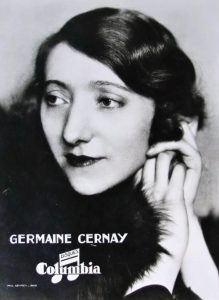
Episode 448. Get to Know Germaine Cernay


Today’s featured artist is, I hope, a name that some of you will at least have heard of: the French mezzo-soprano Germaine Cernay, born Germaine Pointu in Le Havre in 1900 and dying tragically young of an epileptic event in war-torn Paris at the age of only 43. Here is an artist who strikes a balance between poise and white heat, with a voice of exquisite timbre anchored by a flawless technique. Between making her debut at the Opéra-Comique in 1927 and her early retirement from her singing career the year before her death with the intention of becoming a nun, Cernay was a prodigious recording artist and a habituée of both the operatic stage and the concert platform. Today’s episode presents her in her core operatic repertoire (Debussy, Fauré, Mascagni, Bizet, Thomas, and Saint-Saëns), with a strong emphasis on the works of Jules Massenet (Werther, Don Quichotte, Thérèse, Le Cid, Hérodiade, Sapho). Cernay is also heard at the outer edges of the mélodie repertoire, singing songs by Charles Bordes, Xavier Leroux, and Georges Dandelot, alongside the more familiar Lalo, Chabrier, and Brahms, not to forget a smattering of operetta. Some of her strongest recordings feature stellar contributions by fellow singers Georges Thill, Arthur Endrèze, André d’Arkor, Roger Bourdin, and Charles Friant. In recent years, even without a sytstematic reissue of her recorded oeuvre, her reputation has only increased, and she is now recognized as a standard-bearer of the French mezzo-soprano repertoire.

Countermelody is the podcast devoted to the glory and the power of the human voice raised in song. Singer and vocal aficionado Daniel Gundlach explores great singers of the past and present focusing in particular on those who are less well-remembered today than they should be. Daniel’s lifetime in music as a professional countertenor, pianist, vocal coach, voice teacher, and author yields an exciting array of anecdotes, impressions, and “inside stories.” At Countermelody’s core is the celebration of great singers of all stripes, their instruments, and the connection they make to the words they sing. By clicking on the following link (https://linktr.ee/CountermelodyPodcast) you can find the dedicated Countermelody website which contains additional content including artist photos and episode setlists. The link will also take you to Countermelody’s Patreon page, where you can pledge your monthly or yearly support at whatever level you can afford.
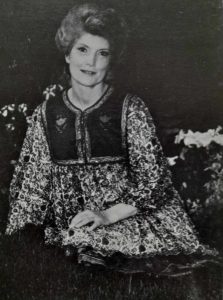


Episode 425. Mady Mesplé chante l’Opérette viennoise


For the final episode of 2025, and of Season Six of the podcast, I present pure frothy escapism from the delectable Mady Mesplé, the finest French coloratura of her generation. My original intention was to feature her exclusively in operetta repertoire, and I’ve stuck to that. But as I began to compile a setlist I realized that there was a subset of her recordings of this repertoire that presented her at her absolute finest: Viennese operetta, as translated into French. From her earliest recordings, operetta was central to her recorded canon, and from 1969 through 1980, she made a choice selection of complete recordings of operetta in French for the Pathé label. Throughout her recorded legacy, there are selections from works such as La veuve joyeuse, (Die lustige Witwe) Trois valses (Drei Walzer), Le pays du sourire (Das Land des Lächelns), Sang viennois (Wiener Blut) and others, which made such a smooth transition into French that they often sounded as if they were could originally have been set in that language. In addition, in the year 1971, Mesplé made a high-flying recording of Johann Strauss waltzes set to French texts that represents her at her vocal zenith. From all of these aforementioned sources, as well as from a 1980 recording of operetta arias with conductor Pierre Dervaux, come the selections for this episode. And for those who would like some Viennese operetta in its original language, the episode begins with the creator records from Franz Lehár’s final original operetta Giuditta, as recorded by Richard Tauber and Jarmila Novotná with Lehár himself conducting the Wiener Philharmoniker. In whichever language you choose, let us waltz our way out of this horrific year into a more humane and livable 2026!

Countermelody is the podcast devoted to the glory and the power of the human voice raised in song. Singer and vocal aficionado Daniel Gundlach explores great singers of the past and present focusing in particular on those who are less well-remembered today than they should be. Daniel’s lifetime in music as a professional countertenor, pianist, vocal coach, voice teacher, and author yields an exciting array of anecdotes, impressions, and “inside stories.” At Countermelody’s core is the celebration of great singers of all stripes, their instruments, and the connection they make to the words they sing. By clicking on the following link (https://linktr.ee/CountermelodyPodcast) you can find the dedicated Countermelody website which contains additional content including artist photos and episode setlists. The link will also take you to Countermelody’s Patreon page, where you can pledge your monthly or yearly support at whatever level you can afford.


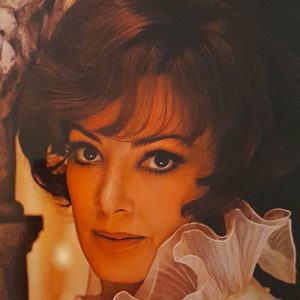
Episode 321. Anna Moffo und die leichte Muse


Today’s episode, “Anna Moffo und die leichte Muse,” continues the delicious theme of opera singers “letting down their hair” begun with “Hadley in Wien,” and it also forms a complement and a supplement to the “Anna Moffo Reappraised” episode that I published exactly two years ago. Anna Moffo’s recording career divides into three separate eras and markets: Italy in the late 1950s and early 1960s; which overlapped with the US in the 1960s; and finally Germany in the 1970s and beyond. Each of these eras in the Moffo career was represented on disc in different ways: jazz arrangements of standards from the Great American Songbook in her earliest (and rarest) Italian recordings, followed by breathy Italian pop songs (some even composed by Moffo herself); early twentieth century Broadway operettas and MGM movie musicals in the US when her voice was at its peak; and Viennese operetta for the German-speaking market, as her vocal instrument became more fragile, while it still represented her finest work of that period. Each of these eras and genres is thoroughly explored in this episode. She is partnered in all of this repertoire by some impressive co-stars: Sergio Franchi, René Kollo, Rudolf Schock, and Robert Merrill as duet partners, with musical direction by Ennio Morricone, Henri René, Lehman Engel, and Skitch Henderson. Recordings range from 1960 through 1983, with the vast majority coming from the 1960s. In spite of the vocal and technical frailty displayed in the later recordings, Moffo’s ability to communicate in this repertoire never flagged. And of course throughout her entire career, no singer so consistently presented a more striking image of vocal and physical glamour than did Anna Moffo.

Countermelody is a podcast devoted to the glory and the power of the human voice raised in song. Singer and vocal aficionado Daniel Gundlach explores great singers of the past and present focusing in particular on those who are less well-remembered today than they should be. Daniel’s lifetime in music as a professional countertenor, pianist, vocal coach, voice teacher, and journalist yields an exciting array of anecdotes, impressions, and “inside stories.” At Countermelody’s core is the celebration of great singers of all stripes, their instruments, and the connection they make to the words they sing. By clicking on the following link (https://linktr.ee/CountermelodyPodcast) you can find the dedicated Countermelody website which contains additional content including artist photos and episode setlists. The link will also take you to Countermelody’s Patreon page, where you can pledge your monthly or yearly support at whatever level you can afford.
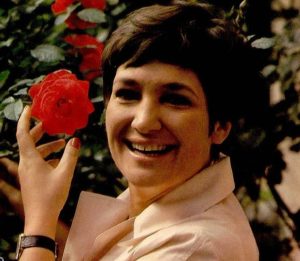


Episode 285. Edda Moser Reappraised


Lately I have been doing a series of episodes on artists that in my opinion deserve a reassessment, a second glance, if you will. Edda Moser is almost universally regarded as the “best” Queen of the Night that ever walked the earth. Certainly she is the most ominous and menacing, as well as the most monumental of voice and delivery. But there is a false narrative surrounding Frau Moser that over the course of her career, she lost control of her voice and pursued a repertoire that destroyed her voice. In this episode, I plead exactly the opposite: that Moser moved naturally and with dedicated assurance into the heavier roles of Strauss and Wagner, and that her voice from its origins displayed affinity for these more dramatic parts. Some of Edda Moser’s earliest successes were in the stratospheric vocal compositions of Hans Werner Henze, in which she displayed a fearless and limitless virtuosity. During her long career, her roles spanned nearly the entire range of the soprano repertoire, everything from her supreme Mozart characterizations to Hanna Glawari to Nedda to Iphigénie to Senta to Salome. Recently, some late-career live recordings of Edda Moser have appeared on the landscape, and instead of recycling one of my two previous Moser episodes, I have selected choice tidbits from these recordings, as well as more readily available material, that show Moser in all facets of her artistry, focusing on the epic, perhaps, but not overlooking her delicacy, sensitivity, pathos, charm, and delicious sense of humor. Guest singers heard on the episode include some of the finest baritones active during this period, including Siegmund Nimsgern, Hermann Prey, Gerd Feldhoff, Claudio Nicolai, and Robert Hale. Conductors include Heinrich Hollreiser, Riccardo Muti, Herbert Blomstedt, Lovro von Matačić, Christoph von Dohnányi, Kent Nagano, and many others. Give this episode a listen and may find yourself agreeing with me that she is one of the supreme classical vocalists of the twentieth century.

Countermelody is a podcast devoted to the glory and the power of the human voice raised in song. Singer and vocal aficionado Daniel Gundlach explores great singers of the past and present focusing in particular on those who are less well-remembered today than they should be. Daniel’s lifetime in music as a professional countertenor, pianist, vocal coach, voice teacher, and journalist yields an exciting array of anecdotes, impressions, and “inside stories.” At Countermelody’s core is the celebration of great singers of all stripes, their instruments, and the connection they make to the words they sing. By clicking on the following link (https://linktr.ee/CountermelodyPodcast) you can find the dedicated Countermelody website which contains additional content including artist photos and episode setlists. The link will also take you to Countermelody’s Patreon page, where you can pledge your monthly support at whatever level you can afford.