Monthly Archives: January 2026

Episode 433. Lois Marshall Revisited


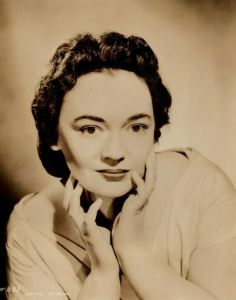
Yesterday, January 29th, was the 101st anniversary of the birth of the Canadian soprano (later mezzo) Lois Marshall. Marshall was in so many ways a unique and treasurable artist. Afflicted with polio as a young child, she spent much of her early life hospitalized. It was there that she discovered the expressive power of her singing voice. Following her training at the Royal Conservatory of Music in Toronto, Marshall won two prestigious vocal competitions, including the Naumburg, she was taken on by such early mentors as Arturo Toscanini and Thomas Beecham and others. Audiences were captivated by both the spontaneity and directness of her artistry. Though she made occasional appearances in opera (and in particular televised opera, where her mobility issues could be more easily managed), she was primarily known as a concert singer. Recommended by the young Glenn Gould, she quickly became a favorite with Russian audiences and created the Canadian premieres of works by Poulenc and Britten, among others. This, the fourth Countermelody episode devoted to this artist, features her in a wide range of material, including in particular work by contemporary Canadian composers including Harry Somers, Oskar Morawetz, Srul Anthony Glick, Godfrey Ridout, Harry Freedman, and Jean Coulthard. The episode also emphasizes the purity and expressiveness of her singing in Baroque music, including Handel, Bach, Purcell, and Schütz as well as her unique way on the concert platform with both art song and folk song arrangements. Collaborating artists include Leopold Stokowski, Maureen Forrester, Glenn Gould, Seiji Ozawa, John Alexander, and Thomas Beecham. Once heard, Lois Marshall will never be forgotten.

Countermelody is the podcast devoted to the glory and the power of the human voice raised in song. Singer and vocal aficionado Daniel Gundlach explores great singers of the past and present focusing in particular on those who are less well-remembered today than they should be. Daniel’s lifetime in music as a professional countertenor, pianist, vocal coach, voice teacher, and author yields an exciting array of anecdotes, impressions, and “inside stories.” At Countermelody’s core is the celebration of great singers of all stripes, their instruments, and the connection they make to the words they sing. By clicking on the following link (https://linktr.ee/CountermelodyPodcast) you can find the dedicated Countermelody website which contains additional content including artist photos and episode setlists. The link will also take you to Countermelody’s Patreon page, where you can pledge your monthly or yearly support at whatever level you can afford.
Episode 432. Dan Picks YET AGAIN!


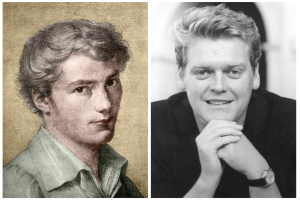
One of the things about my podcast that brings me the greatest joy is when I can introduce my listeners to a wide range of singers that need to be better-known. Back when I was preparing birthday episodes in October, I chose literally hundreds of tracks that I wanted to share with my listeners. At the time I made use of only a handful of them, so today I have once again dipped into that vat of gorgeous, expressive voices to bring another foretaste of what’s to come on the podcast. There’s a special section on some amazing tenors (Alain Vanzo, Wiesław Ochman, George Thill, Anton de Ridder, Richard Lewis, Charles Kullman and many others); I also introduce a plethora of singers of color who will be appearing throughout Black History Month (Madeline Bell, Bertice Reading, Maxine Sullivan, the late Iris Williams, Adelaide Hall, Roland Hayes, Faye Robinson, and Toni Harper, along with many others). It’s offered in a spirit of solidarity, communal sharing, and generosity as we face together the tough times ahead.

Countermelody is the podcast devoted to the glory and the power of the human voice raised in song. Singer and vocal aficionado Daniel Gundlach explores great singers of the past and present focusing in particular on those who are less well-remembered today than they should be. Daniel’s lifetime in music as a professional countertenor, pianist, vocal coach, voice teacher, and author yields an exciting array of anecdotes, impressions, and “inside stories.” At Countermelody’s core is the celebration of great singers of all stripes, their instruments, and the connection they make to the words they sing. By clicking on the following link (https://linktr.ee/CountermelodyPodcast) you can find the dedicated Countermelody website which contains additional content including artist photos and episode setlists. The link will also take you to Countermelody’s Patreon page, where you can pledge your monthly or yearly support at whatever level you can afford.

Episode 431. Hermann Prey singt Schubert Orchesterlieder


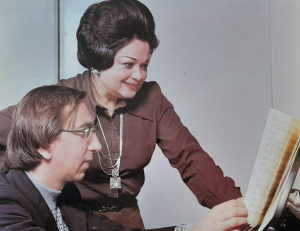
I’m sure many of you balked when you saw the title of this episode: “But Daniel: Schubert wrote no orchestral songs!” And of course you would be correct. And yet, what about when other composers orchestrate his songs? Therein lies the content of today’s episode. Historical evidence from some of Schubert’s contemporaries and closest associates indicate that he was strict in both tempo and affect in the performance of his Lieder. And yet, in the later 19th century (and beyond) many of his songs were orchestrated by such masters of orchestral color as Reger, Berlioz, Brahms, Liszt, Weingartner, and Mottl. In the twentieth century, individual songs have been orchestrated by such unexpected composers as Britten and Webern. In the late 1970s, Hermann Prey and conductor Gary Bertini made two LPs of the first recordings of these orchestrations and they make for fascinating listening, as these songs are transformed from the distinct genre of Klavierlieder to that of Orchesterlieder. These two records are supplemented by excerpts of  a recording of a live performance by Hermann Prey of the world premiere of an orchestrated version of Winterreise by Japanese composer Yukikazu Suzuki. Even less than a year before his death, Prey’s connection to the music of Schubert remains palpable, and the slight vocal vulnerabilities from that performance serve only to intensify and deepen Prey’s interpretation.

Countermelody is the podcast devoted to the glory and the power of the human voice raised in song. Singer and vocal aficionado Daniel Gundlach explores great singers of the past and present focusing in particular on those who are less well-remembered today than they should be. Daniel’s lifetime in music as a professional countertenor, pianist, vocal coach, voice teacher, and author yields an exciting array of anecdotes, impressions, and “inside stories.” At Countermelody’s core is the celebration of great singers of all stripes, their instruments, and the connection they make to the words they sing. By clicking on the following link (https://linktr.ee/CountermelodyPodcast) you can find the dedicated Countermelody website which contains additional content including artist photos and episode setlists. The link will also take you to Countermelody’s Patreon page, where you can pledge your monthly or yearly support at whatever level you can afford.



Episode 430. Soukupová in Song


Here’s a rare sampling of Countermelody favorite, the refulgent Czech contralto Věra Soukupová, in song repertoire, accompanied by both piano and full orchestra. The featured works are two song cycles of the so-called “late Romantic era,” one by Antonín Dvořák (his 1894 Biblical Songs), and one by Gustav Mahler, his 1901 Kindertotenlieder cycle. The Dvořák recording stems from 1967 and features Czech pianist Ivan Moravec; the Mahler is from 1963 and features the great Czech conductor (and Mahler specialist) Václav Neumann leading the Czech Philharmonic. The setlist includes two additional Mahler orchestral songs with Soukupová and Neumann as well as excerpts from Soukupová’s 1976 recording of two song cycles by Robert Schumann, accompanied by Czech pianist Jan Horák.

Countermelody is the podcast devoted to the glory and the power of the human voice raised in song. Singer and vocal aficionado Daniel Gundlach explores great singers of the past and present focusing in particular on those who are less well-remembered today than they should be. Daniel’s lifetime in music as a professional countertenor, pianist, vocal coach, voice teacher, and author yields an exciting array of anecdotes, impressions, and “inside stories.” At Countermelody’s core is the celebration of great singers of all stripes, their instruments, and the connection they make to the words they sing. By clicking on the following link (https://linktr.ee/CountermelodyPodcast) you can find the dedicated Countermelody website which contains additional content including artist photos and episode setlists. The link will also take you to Countermelody’s Patreon page, where you can pledge your monthly or yearly support at whatever level you can afford.

Episode 429. A Smattering of Sopranos


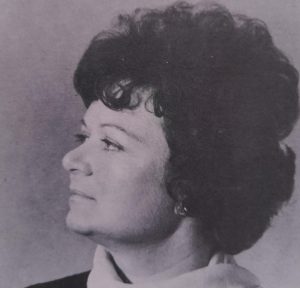
Today’s episode reveals and celebrates the opera queen in me: it’s a program entitled “A Smattering of Sopranos” that features twenty-five different singers who “happen to be” sopranos and whom have not yet been featured in full episodes of the podcast. I love producing these “potpourri” episodes, which allow me to offer a marvelous sampling of singers in a wide-ranging repertoire from French, German, Italian, (and Polish!) opera to religious music to orchestral song to Deutsche Schlager to Lieder and melodies to Russian romances to the Great American Songbook. Singers heard include Suzanne Danco, Rita Shane, Raina Kabaivanska, Françoise Pollet, Maggie Teyte, Phyllis Curtin, Jarmila Novotná, Florence Quartararo, Janine Micheau, Stefania Woytowicz, Olive Moorefield, Elisabeth Rethberg, and the late Stefka Evstatieva, among many others and each one puts her distinctive stamp on the material.

Countermelody is the podcast devoted to the glory and the power of the human voice raised in song. Singer and vocal aficionado Daniel Gundlach explores great singers of the past and present focusing in particular on those who are less well-remembered today than they should be. Daniel’s lifetime in music as a professional countertenor, pianist, vocal coach, voice teacher, and author yields an exciting array of anecdotes, impressions, and “inside stories.” At Countermelody’s core is the celebration of great singers of all stripes, their instruments, and the connection they make to the words they sing. By clicking on the following link (https://linktr.ee/CountermelodyPodcast) you can find the dedicated Countermelody website which contains additional content including artist photos and episode setlists. The link will also take you to Countermelody’s Patreon page, where you can pledge your monthly or yearly support at whatever level you can afford.

Episode 428. Alfreda Hodgson Sings Brahms


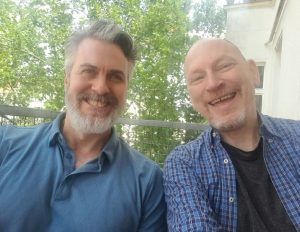
The English contralto Alfreda Hodgson (07 June 1940 – 16 April 1992) has been featured numerous times on Countermelody and when I recently acquired a copy of her 1980 solo recital recording originally released on Pearl Records, I decided that the time was right to do a full episode on this rich-voiced, profoundly musical singer. Though she was equally superb in Bach, Mahler, Handel, and Elgar, I have chosen to focus on her performances of the music of Johannes Brahms, including superb recordings of the Alto Rhapsody, the Songs for Alto and Viola, the Vier ernste Gesänge, and a posthumously-assembled collection of his Lieder published under the title Mädchenlieder. Artists accompanying Hodgson include Bernard Haitink, Edward Downes, violist Ludmila Navrath, and her long-standing pianist, the late Keith Swallow. I begin the episode with brief examples of Hodgson singing (in English) the music of her countrymen Lennox Berkeley, Edward Elgar, and John Ireland in the company of Peter Pears, Gennady Rozhdestvensky, Steuart Bedford, and Alan Rowlands.

Countermelody is the podcast devoted to the glory and the power of the human voice raised in song. Singer and vocal aficionado Daniel Gundlach explores great singers of the past and present focusing in particular on those who are less well-remembered today than they should be. Daniel’s lifetime in music as a professional countertenor, pianist, vocal coach, voice teacher, and author yields an exciting array of anecdotes, impressions, and “inside stories.” At Countermelody’s core is the celebration of great singers of all stripes, their instruments, and the connection they make to the words they sing. By clicking on the following link (https://linktr.ee/CountermelodyPodcast) you can find the dedicated Countermelody website which contains additional content including artist photos and episode setlists. The link will also take you to Countermelody’s Patreon page, where you can pledge your monthly or yearly support at whatever level you can afford.

Episode 427. Representative Andrew Gray [AK] (Countermelody Conversations)


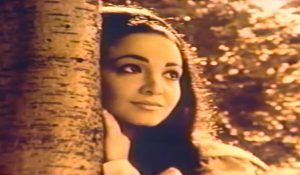
In the past I have featured interviews with wonderful guests (including Ira Siff, Janet Williams, Nicholas Tamagna, August Ventura, David Savran, and others), but they have been few and far between. The vast majority of my episodes consist of me talking solo about whatever singer or topic I am presenting on a given day. But today, alongside the new season of Countermelody, I also initiate a new series called “Countermelody Conversations,” in which I interview friends and colleagues in (and out of) the music business, discussing music, singers, singing, and all the issues that come up in such discussions. My first guest in this series is my good friend Andrew Gray. Many years (and lifetimes) ago, Andrew was a voice student of mine. Most voice teachers, when bragging about their students, tell you what opera houses they have been singing in. But Andrew is associated with an altogether different house, the Alaska State House of Representatives, of which he is a recently re-elected member. In this episode, Andrew describes how he went from being a Broadway wannabe to a politician. As he himself states, he is content that he has now found his true calling, but it is wonderful to trek that journey with him. I interviewed Andrew last summer when he and his son visited Berlin. He brought along a fascinating setlist of some of his favorite music, which we also discuss in detail. Andrew has a way of listening to and evaluating music which is distinctly different from mine, which means that he presents music and singers that you might otherwise not encounter on Countermelody. I’m so proud to have him as the first guest on this new series, for which I’m already planning subsequent conversations.

Countermelody is the podcast devoted to the glory and the power of the human voice raised in song. Singer and vocal aficionado Daniel Gundlach explores great singers of the past and present focusing in particular on those who are less well-remembered today than they should be. Daniel’s lifetime in music as a professional countertenor, pianist, vocal coach, voice teacher, and author yields an exciting array of anecdotes, impressions, and “inside stories.” At Countermelody’s core is the celebration of great singers of all stripes, their instruments, and the connection they make to the words they sing. By clicking on the following link (https://linktr.ee/CountermelodyPodcast) you can find the dedicated Countermelody website which contains additional content including artist photos and episode setlists. The link will also take you to Countermelody’s Patreon page, where you can pledge your monthly or yearly support at whatever level you can afford.


Episode 426. Teresa Stratas [Season Seven Premiere]


I wanted to start off the year (and the new season of the podcast) with something momentous, and who better to take us there than one of the great operatic artists of the twentieth century: Canadian soprano Teresa Stratas. I have not yet done a full episode on this artist, though she provided me with what was probably my greatest night in the opera house (I get into that in the episode, as well as featuring a rare excerpt of her in that shattering performance). As always with my podcast, I like to provide unexpected glimpses of such a great singer, alongside many of her most legendary moments. So not only do we hear Stratas’ legendary interpretations of her favorite roles (Mimì, Mélisande, Lulu, Violetta, and Salome [the latter a role she never portrayed onstage]), we also hear her in Mozart, her favorite composer, as an operetta singer, as an interpreter of Lieder, in her single Broadway role in the short-lived Rags, and in another of her creations, the title role in Australian composer Peggy Glanville-Hicks’ Nausicaa, as well as two late career Met roles, Liù and the Komponist, roles she had sung there at the beginning of her career, more than thirty years earlier. Along the way, we hear her with artists who have already been featured in previous seasons (Gabriel Bacquier, Florence Quivar and Fritz Wunderlich), but also singers who will each be featured in the upcoming series of the podcast, including Tom Krause, Wiesław Ochman, Bernd Weikl, Elizabeth Harwood, and Vasile Moldoveanu. Also much discussion also about what makes Stratas unique as an interpreter, and why she deserves to be ranked among the very greatest. Welcome to Season Seven!

Countermelody is the podcast devoted to the glory and the power of the human voice raised in song. Singer and vocal aficionado Daniel Gundlach explores great singers of the past and present focusing in particular on those who are less well-remembered today than they should be. Daniel’s lifetime in music as a professional countertenor, pianist, vocal coach, voice teacher, and author yields an exciting array of anecdotes, impressions, and “inside stories.” At Countermelody’s core is the celebration of great singers of all stripes, their instruments, and the connection they make to the words they sing. By clicking on the following link (https://linktr.ee/CountermelodyPodcast) you can find the dedicated Countermelody website which contains additional content including artist photos and episode setlists. The link will also take you to Countermelody’s Patreon page, where you can pledge your monthly or yearly support at whatever level you can afford.