Tag Archives: Jimmy McHugh

Episode 469. Muriel and Angela: Together Again for the First Time


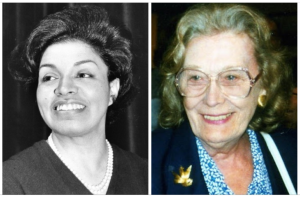
Today’s Pride episode foregrounds trans pioneer Angela Morley (10 March 1924 – 14 January 2009), who achieved great fame in her native England as a composer, arranger and conductor of popular music, becoming the music director for the British division of Philips records in 1953. She transitioned in 1970 and went public with her new name in 1972. She subsequently moved with her second wife Christine to the United States, where she was deeply involved in creating and arranging music for some of the most highly acclaimed movies and television shows of that era. She was twice nominated for an Oscar (the first out trans person to be so acclaimed) and won three Emmy Awards. In her association with Philips, she was the arranger and conductor for all the pop records made by African American icon Muriel Smith (23 February 1923 – 13 September 1985), probably best known for creating the title role in Oscar Hammerstein’s musical Carmen Jones. Smith moved to the UK in the early 1950s and achieved enormous acclaim and recognition for her stage portrayals in the West End of the British premieres of South Pacific and The King and I before returning to the United States in the early 1960s. These recordings, made between 1953 and 1955, are noteworthy both for Smith’s unique way of connecting with her musical material as well as for Morley’s lush and varied musical arrangement. When I first discovered Muriel Smith during the first year of Countermelody, I made it a goal to collect all her elusive yet remarkable Philips recordings, promising to celebrate that accomplishment with my listeners once I finally attained it. Just last week, I finally secured my last Morley/Smith 78. So here, finally, is that very special episode, replete with Smith’s intensely personal song stylings backed by the evocative arrangements of Angela Morley (for once identified in these recordings under her post-transition name).

Countermelody is the podcast devoted to the glory and the power of the human voice raised in song. Singer and vocal aficionado Daniel Gundlach explores great singers of the past and present focusing in particular on those who are less well-remembered today than they should be. Daniel’s lifetime in music as a professional countertenor, pianist, vocal coach, voice teacher, and author yields an exciting array of anecdotes, impressions, and “inside stories.” At Countermelody’s core is the celebration of great singers of all stripes, their instruments, and the connection they make to the words they sing. By clicking on the following link (https://linktr.ee/CountermelodyPodcast) you can find the dedicated Countermelody website which contains additional content including artist photos and episode setlists. The link will also take you to Countermelody’s Patreon page, where you can pledge your monthly or yearly support at whatever level you can afford.


Episode 436. Adelaide Hall, Sophisticated Lady


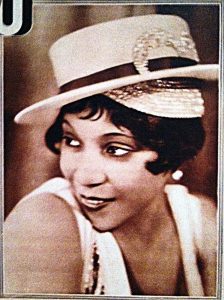
Adelaide Hall (1901 – 1993), entertainer extraordinaire, really had it all: voice, talent, beauty, dancing chops, charisma, joie de vivre and sophistication. She was the first Black performer to attain international stardom, even before Joséphine Baker, with whom she shared a number of similarities (though Hall probably had the superior voice). She was the first singer to scat on record; she helped popularize both the Charleston and the Black Bottom and was considered the epitome of the Flapper; she introduced the world to a number of now-standard songs from the Great American Songbook; she appeared on a rare 1935 Vitaphone short that featured all Black performers; she and her husband owned and ran various night clubs in three different countries, as well as headlining at the legendary Cotton Club; and she headlined the sensational revue Blackbirds of 1928 and several other ground-breaking shows in the 1920s and 1930s. I got to know her work many years back when I happened to find a late-career LP of hers in the basement of an apartment building I was living in. I have been a fan ever since. The number of great musicians with whom she rubbed shoulders is almost mind-boggling (Duke Ellington, Fats Waller, Louis Armstrong, Fela Sowande, Joe Turner, and Art Tatum, for starters), and she continued to perform with gusto and sophistication into her late eighties, occasionally returning to her native US from London, where she settled in 1938 and lived until her death. Her range of influence is truly far-flung and her many recordings, made between 1927 and 1989, a generous sampling of which are offered on this episode, continue to bring consistent delight and surprise.

Countermelody is the podcast devoted to the glory and the power of the human voice raised in song. Singer and vocal aficionado Daniel Gundlach explores great singers of the past and present focusing in particular on those who are less well-remembered today than they should be. Daniel’s lifetime in music as a professional countertenor, pianist, vocal coach, voice teacher, and author yields an exciting array of anecdotes, impressions, and “inside stories.” At Countermelody’s core is the celebration of great singers of all stripes, their instruments, and the connection they make to the words they sing. By clicking on the following link (https://linktr.ee/CountermelodyPodcast) you can find the dedicated Countermelody website which contains additional content including artist photos and episode setlists. The link will also take you to Countermelody’s Patreon page, where you can pledge your monthly or yearly support at whatever level you can afford.


Episode 271. Muriel Smith (Listeners’ Favorites)


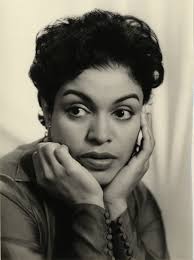
As I embark on several weeks of vacation, I bring you the first of several episodes from the early years of the podcast in between the new episodes that I will produce with somewhat less frequency between now and September. This week I am honored to bring to you the first of two episodes from the Season One of Countermelody which introduced my listeners to the great African American mezzo-soprano Muriel Smith (1923-1985) who, among other important contributions, premiered the title role of Carmen Jones on Broadway in 1943. We examine her work in musicals and films as well as pop music and opera. Her eclecticism, her ability to color her voice in a way uniquely suited to the wide range of roles she undertook, as well as her deep connection to text and expression, mark her as an artist of the highest caliber. Featured is a rare 1955 Philips recording of spirituals represents Muriel Smith at her artistic and interpretive peak.

Countermelody is a podcast devoted to the glory and the power of the human voice raised in song. Singer and vocal aficionado Daniel Gundlach explores great singers of the past and present focusing in particular on those who are less well-remembered today than they should be. Daniel’s lifetime in music as a professional countertenor, pianist, vocal coach, voice teacher, and journalist yields an exciting array of anecdotes, impressions, and “inside stories.” At Countermelody’s core is the celebration of great singers of all stripes, their instruments, and the connection they make to the words they sing. By clicking on the following link (https://linktr.ee/CountermelodyPodcast) you can find the dedicated Countermelody website which contains additional content including artist photos and episode setlists. The link will also take you to Countermelody’s Patreon page, where you can pledge your monthly support at whatever level you can afford. Bonus episodes available exclusively to Patreon supporters are currently available and further bonus content including interviews and livestreams is planned for the upcoming season.


Episode 267. A Cavalcade of Pop Contraltos


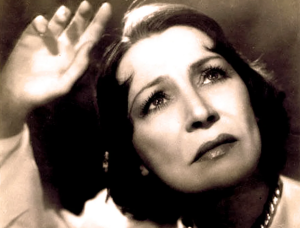
My intention this week to produce a joyous new episode further celebrating contraltos, was undermined by multiple deaths this past week in the musical world, including French pop icon Françoise Hardy, Swiss tenor Eric Tappy, American art song icon Paul Sperry, and R&B diva Angela Bofill, capped by the tragic demise of young Belgian coloratura soprano Jodie Devos of breast cancer at the age of only 35. The episode, thus, begins with brief musical excerpts from all of these recently departed artists. In the main episode, I spread the contralto net even wider than last time, focusing on low-voiced doyennes of popular song. We hear jazz singers (Betty Carter, Sarah Vaughan, Carmen McRae); stars of stage, screen, and radio (Marlene Dietrich, Polly Bergen, Connee Boswell, Alice Faye, Lisa Kirk, Kate Smith); purveyors of the Blues (Bessie Smith, Bertice Reading); French cabaret singers (Damia, Barbara); fado, rebetika, and tango artists (Amália Rodrigues, Milva, Maria Bethânia, Sotiria Bellou); and late-20th century pop icons (Cher, Tina Turner, Karen Carpenter, Annie Lennox); with a few delightful surprises along the way. I should also note, in honor of Pride Month, that more than a few of these artists flaunted societal norms regarding their affectional preferences, living either furtively or openly at a time when such expressions could have serious consequences. I love putting this kind of episode together and I hope that you enjoy the kaleidoscopic sounds that emerge from the throats of these deep-voiced pop divas.

Countermelody is a podcast devoted to the glory and the power of the human voice raised in song. Singer and vocal aficionado Daniel Gundlach explores great singers of the past and present focusing in particular on those who are less well-remembered today than they should be. Daniel’s lifetime in music as a professional countertenor, pianist, vocal coach, voice teacher, and journalist yields an exciting array of anecdotes, impressions, and “inside stories.” At Countermelody’s core is the celebration of great singers of all stripes, their instruments, and the connection they make to the words they sing. By clicking on the following link (https://linktr.ee/CountermelodyPodcast) you can find the dedicated Countermelody website which contains additional content including artist photos and episode setlists. The link will also take you to Countermelody’s Patreon page, where you can pledge your monthly support at whatever level you can afford.
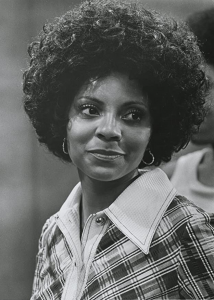

Episode 128. Leslie Uggams (Black History Month 2022)


I would bet (though I can’t guarantee it) that I was one of a very small number of white 8-year-old Wisconsin boys who, on Sunday nights in the summer of 1969, tuned in faithfully to watch every single episode of the short-lived variety series, The Leslie Uggams Show. Ever since encountering her on that groundbreaking show, I have loved Ms. Uggams: her combination of vivacious high spirits, powerhouse vocalism, and personal style and beauty has always enchanted me. Her performing career began long before I was born, when she appeared as a child star on various television competitions and series, later creating television history in the early sixties as a star of Sing Along with Mitch. Later she starred in a central role in 1977’s Roots, the miniseries that changed the face of television. Her popularity continues to the present day, with her appearances in such series as Empire and such films as the Deadpool franchise. Some of her more recent fans may not realize that she was also a vital performer in musicals and theatre, including her Tony-Award-winning performance in Hallelujah, Baby! in 1968 and performances in regional theatre of some of the most iconic female starring roles, including Mama Rose, Dolly Levi, and Mame Dennis. In this episode feature her in sung performances over the course of more than 60 years with special focus on her recorded work from the late 1960s. Whether you are an old or a new fan, I hope that you will be as beguiled by Leslie Uggams as I always have been.

Countermelody is a podcast devoted to the glory and the power of the human voice raised in song. Singer and vocal aficionado Daniel Gundlach explores great singers of the past and present focusing in particular on those who are less well-remembered today than they should be. Daniel’s lifetime in music as a professional countertenor, pianist, vocal coach, voice teacher, and journalist yields an exciting array of anecdotes, impressions, and “inside stories.” At Countermelody’s core is the celebration of great singers of all stripes, their instruments, and the connection they make to the words they sing. By clicking on the following link (https://linktr.ee/CountermelodyPodcast) you can find the dedicated Countermelody website which contains additional content including artist photos and episode setlists. The link will also take you to Countermelody’s Patreon page, where you can pledge your monthly support at whatever level you can afford. Bonus episodes available exclusively to Patreon supporters are currently available and further bonus content including interviews and livestreams is planned for the upcoming season.


Episode 35. Charm: A Second Helping


Last week we had such an overflowing of vocal, artistic, and personal charm that I was compelled to produce a second episode on the subject with a fresh batch of charmers. We begin the episode with a tribute to Gabriel Bacquier, the iconic French (bass-)baritone who died this past week just four days short of his 96th birthday. I feature him in three rare selections that represent him in repertoire which is a far cry from his operatic roles. I then resume the survey of charm as demonstrated by artists as varied as Conchita Supervia, Joséphine Baker, Hilde Güden, Ella Fitzgerald, Yvonne Printemps, John McCormack, Lois Marshall, Charles Trenet, Lucrezia Bori, Lily Pons, Hermann Prey, Dusolina Giannini, Tito Schipa, Richard Tauber, Julie Andrews, Julius Patzak, Maria Kurenko, Judith Blegen, Danny Kaye, Marta Eggerth, Elisabeth Schumann, Fritzi Massary, Maxine Sullivan, Magda Kalmár, Ella Logan, Dorothy Warenskjold, Aksel Schiøtz, Erich Kunz, and Lucia Popp. Repertoire ranges from operetta (including Franz Lehár in three different languages), folk song arrangements, musicals, art song, pop music, and children’s songs. Amazingly, opera is nowhere to be seen in this episode, but that will certainly change in the next week, when we take up consideration of Charm’s cousin, Glamour.

Countermelody is a podcast devoted to the glories of the human voice raised in song. Singer and vocal aficionado Daniel Gundlach explores great classical and opera singers of the past and present with the help of guests from the classical music field: singers, conductors, composers, coaches, agents, and voice teachers. Daniel’s lifetime in music as a professional countertenor, pianist, vocal coach, voice teacher, and journalist yields an exciting array of anecdotes, impressions, and “inside stories.” At Countermelody’s core is the interaction between singers of all stripes, their instruments, and the connection they make to the words they sing. Please visit the Countermelody website (www.countermelodypodcast.com) for additional content. And please head to our Patreon page at www.patreon.com/countermelody to pledge your monthly support at whatever level you can afford.


Episode 20. Muriel Smith (Black History Month I)


This week kicks off my series of Black History Month episodes, in which I pay homage to some less well-remembered African American singers who nonetheless made an enormous impact in the world of music. This week I am honored to bring to you the great mezzo-soprano Muriel Smith (1923-1985) who, among other important contributions, premiered the title role of Carmen Jones on Broadway in 1943. We examine her work in musicals and films as well as pop music and opera. Her eclecticism, her ability to color her voice in a way uniquely suited to the wide range of roles she undertook, as well as her deep connection to text and expression, mark her as an artist of the highest caliber. Featured is a rare 1955 Philips recording of spirituals represents Muriel Smith at her artistic and interpretive peak.

Countermelody is a new podcast devoted to the glories of the human voice raised in song. Singer and vocal aficionado Daniel Gundlach explores great classical and opera singers of the past and present with the help of guests from the classical music field: singers, conductors, composers, coaches, agents, and voice teachers. Daniel’s lifetime in music as a professional countertenor, pianist, vocal coach, voice teacher, and journalist yields an exciting array of anecdotes, impressions, and “inside stories.” At Countermelody’s core is the interaction between singers of all stripes, their instruments, and the connection they make to the words they sing. Please also visit the Countermelody website for updates, additional content, and to pledge your support. www.countermelodypodcast.com